Sunday, September 22, 2013

Getting On Board


I have been reading an advance copy of a soon-to-be-released book, The Bully’s Trap, by Andrew Faas. The subject is corporate bullying and the effect it has on the business climate across North America and Europe. The book sheds light on a topic that is underappreciated, but has an enormous impact on the bottom line of most companies, and definitely on the health and well being of its employees. I will be exploring this subject much further, but the topic did get me thinking about the responsibilities of boards of directors in general. Having served on dozens of boards, I have seen my fair share of board dynamics. Here are just a few of my observations.


1.    In an effort to economize on valuable time, any efficient board, whether for profit corporation or a not-for-profit charity, will ask its various committees to submit committee reports ahead of time so members can read them and be prepared to ask any questions they may have. Too often, committee members fail to read these advance reports, and as a result, tend to ask questions already answered within said report. This not only wastes the time of the rest of the group, it also points out a lack of interest and respect for the organization. If one is to be taken seriously, a person must take their responsibilities seriously.


2.    Some people have a habit of arriving late to a meeting. This is unacceptable. Meetings need to begin on time and end on time. One should not be penalized for showing up on time. It’s not as though meetings are called suddenly. In fact, most meetings are scheduled far in advance giving everyone an equal opportunity to be on time.


3.    Many people today are addicted to their cell phones and fail to turn them off (or put them on vibrate) when they go to a meeting. This is also unacceptable. When one attends a meeting, one’s undivided attention is required.


4.    Discussions tend to wander off topic. Keeping a meeting moving along smoothly and staying on topic is the responsibility of the chairperson. However, it is also the duty of each member to respect others and not fall prey to ancillary discussions.


5.    Whispering to others at a meeting with comments and asides is a very common occurrence. There is little that is more disruptive than whispering. Not only does it serve to distract the rest of the group, those who are engaged in this distraction cannot be listening to what the speaker is saying.

6.    Inevitably, there is going to be someone who dominates the discussion. These know-it-alls have free-range egos that seem unsatisfied until they get their way. Everyone is entitled to his or her opinion and forcing oneself on a group by raising one’s voice, or other grandstanding tactic is selfish and counterproductive.


Oddly enough, all of these behaviors are rude, and they are also a form of bullying. Some may argue that the term is overused. I take the opposite point of view. I think the act is much farther reaching than many people realize. This unhealthy behavior has developed and continued because no one has recognized the severity of the damage it can cause or has done anything to stop it. There is no better time than the present to begin to change these harmful practices.


When one agrees to serve on a board of directors, it is important to understand exactly what one’s responsibilities will be and what kinds of commitments are expected. A rule of thumb is that every board member must be able to give or get two of the following three things – time, skill, and money. By learning and really understanding what is expected, a board can be most effective. Without this, a board can bring an organization to its knees.


I highly recommend every not-for-profit organization with a board of directors have a copy of Before You Say Yes, a book by Doreen Pendgracs to which I have contributed bits and pieces of advice. In it many questions are answered on how to go about the decision making process of accepting or declining the offer of a position on a board. A lot of nasty surprises and disappointments would be avoided if people did their homework before leaping onto a board.

The responsibilities of a board are many. They are to be taken seriously. Learning what defines one’s role is crucial. I suggest doing one’s homework before one accepts a position thus avoiding a whole lot of hassle. Once one makes the decision to join a board, there are endless opportunities to do great things! 

Monday, September 2, 2013

On Hosting


One of the benefits of traveling and visiting friends from time to time that live a good distance away is being invited out for lunches and dinners. Everyone has his or her own style of entertaining. Given my profession, I notice a lot of the fine points of what hosts do to make a party a success. Some hosts have a natural ability to make their guests feel welcome, while others do not. For instance, guests do not want to stand around holding their coat, hostess gift or bottle of wine while the host is otherwise engaged, seemingly unaware of the latest arrival? 


It amazes me how often guests are simply ignored or are allowed to stand awkwardly by without being acknowledged. This occurs not only in private homes but in restaurants as well. By following a few simple guidelines our guests will feel more than welcome; they will feel special!

A mentor of mine with a lifetime of experience as a host to all kinds of people reminds us to “avoid the avoidable”. We can accomplish this most easily by making a plan ahead of time and sticking to it. This plan works most effectively and efficiently if it follows a time line. Begin with issuing invitations and conclude with serving after dinner coffee. Considerations include deciding how many guests to invite, what the menu will be, and what the tone of the party will be. We all have our priorities and different styles of entertaining. I have always been a proponent of flexibility and fun and do not believe that there is a clear-cut black and white way to do anything. Only in the most formal situations does strict protocol come into play.


Conventional wisdom or common sense might dictate deciding on the guest list, followed by the menu, the various table wears and finally the flowers or other centerpiece, all in that order. I find choosing the flowers first or the menu first can help set the tone for the party and may well influence the guest list. An example might be a lobster boil or a mussel feast. Inviting people who are allergic to shellfish could be problematic. Cooking two menus – one for those who will enjoy the lobster, and one for those who wouldn’t, can be hectic at best. If you enjoy hosting parties then by all means have several and your food allergy problems will be blissfully solved.

Most of us have rather impromptu dinners with invitations delivered by a phone call or even an email. Being a traditionalist, I am not likely to issue invitations (not invites, by the way) via email, but this seems to be a growing trend, and for informal gatherings I say, “Why not”? For more formal gatherings, handwritten invitations are proper, but amongst close friends the trend towards phoning is gaining ground. I draw the line with text messaging and social media being off limits and just plain lazy. Given the amount of effort one puts into planning, preparing and hosting a party, the time required to send an invitation is minimal and it gives real style to any event. My advice is to go the extra mile. Your guests will notice the effort!


If you are cooking the meal at home, resist trying a recipe you haven’t tested before. Not all recipes actually work, especially if your culinary skills are a bit rusty. Plan a menu that can be prepared ahead of time, with perhaps a bit of a warm up or last-minute carving, if at all possible. This allows a host to be gracious and focus more attention on guests.

Be ready to greet your guests when they arrive. Let them know where they hang their coats, leave their shoes (if you have a shoes-off policy), and offer them a beverage. This of course means having a bar set up complete with ice and glasses. Many parties in the Maritimes are BYOB affairs; some are not. With the decline in the consumption of hard liquor and an increase in beer and wine, be sure to have a designated area where beverages can be kept cold.


As the afternoon or evening progresses, keep an eye on each of your guests, making an effort to have a meaningful conversation with each one. If you are seating the dinner party at a table or group of tables, place cards do come in handy. They are not pretentious and actually help guests. This also allows you to control where people sit, being sure that husbands and wives to not sit next to one another, but that dating couples do. Small children should be seated next to or very near their parents.

Try to position yourself near the door as the party comes to an end to make it easier for guests to thank you properly. Keep in mind when saying good night not to engage in lengthy conversations and hold other guests up who are trying to leave at the same time. Let common sense and awareness prevail.


These guidelines should help to maximize your guests’ enjoyment and make you look like a star!


Saturday, August 3, 2013

Baking with a Bully


Dear Etiquette Guy,

  I am in a bit of a dilemma. My stepson was having trouble with a particular child in his class during the school term and now with summer activities in full swing, they’re in some of the same groups, and the bully was really having a go at my youngster. I decided to step in, but not in the usual way. One Saturday afternoon, I invited Bully Boy, as I named him, to get to know me, on his own, in my home. I called his mother and asked if it would be okay to get acquainted with her son quietly, on our own. With a bit of hesitation, she agreed. 


On the chosen day, my stepson was going to be away, so that Bully Boy and I could spend a few hours hanging out. On my agenda was chocolate chip cookie baking. I figured since my little guy liked to help, this high-energy classmate might like to use his hands for something other than punching. Fast forward through our afternoon and I learned something – this kid LOVED baking; reading the recipe out loud, checking the measurements twice, and sneaking in more chocolate chips J, but not without a mischievous grin. Clearly this boy was enjoying the attention, and said he was really having fun. Was I onto something?

 After we washed up all the mixing bowls and spoons, we sat down and had cookies and milk. It was clear Bully Boy was very pleased with himself – the sullen face that greeted me earlier was replaced with a big smile and sparkling eyes. In a few short hours, he became Baker Boy! It’s like something was truly lit up in him, and he liked it. I packed up a dozen of HIS cookies in a brown paper bag for him to take home to share with his younger sister and his mother. He asked if he could come back again because he had so much fun. What to say? I told him I would call his mother.


My question: would it be over-stepping if I did invite him for another baking date? Perhaps including his mother? My worry is that he might get too attached to me and I’d be faced with two problems – my stepson might become jealous, or this boy’s mother might think I’m interfering/overstepping. From my perspective, I see potential in a few more dates with my new little friend  – in the vein of paying it forward. His accomplishments on our baking day may be just the thing to propel him forward into more positive situations where he realizes that he doesn’t have to bully to get what he wants or needs.  I’m thinking pizza dough next. Then he could have his own pizza making party at his house! J

  I’m looking forward to your take on this situation.

Thank you,

The CAKE Lady

Dear Cake Lady,
This is indeed a heartwarming story and needs to continue. What I advise is to invite this young man over when your stepson is home and the two boys could experience teamwork in the kitchen. Perhaps they will discover that their strengths can compliment each other rather than one being ‘better’ than the other.
I have experienced bullying on many levels over many years. It is painful to endure and in the end has no benefit. Bullies learn this behavior at home initially and the behavior often goes unchecked at school and then continues through life including marriages and professional lives. Bullying is decimating the bottom line of many companies today.


What a golden opportunity to redirect this considerable energy in a healthy way. Establishing relationships with our peers at an early age is critical to maintaining a civil society.
I well remember experiencing the transformation as a child of taking back my power at the knee of the mother of a friend of mine who was well aware of the bullying I was experiencing in my own house. We would visit every afternoon on my way home from school. I would have a Coke and we would chat. I came to realize that I wasn’t really the weak person I had been belittled to believe. I had value and my feelings were valid.
I recently gave a talk where this woman, now over 80, came to hear me. I referenced her act of kindness publicly and you could have heard a pin drop. People do relate to these stories because we all have experienced them. Whether it is at home, at school, in a relationship, or in business, it’s never too late to address this dynamic.
Please let me know how this story unfolds. I am sure the readers of this column will want to know. I know I will.
Kind regards,
EG

Monday, July 29, 2013

To Touch or Not To Touch - That is the Question


How we greet one another appears to have evolved into a variety and at times bizarre ways of expressing our enthusiasm for seeing a familiar face. A reader wrote to ask about the etiquette of what is or may not be appropriate when we meet others.


Dear Jay:

My question is about appropriate touches between two male friends. I'm not sure if this is the right category for my questions, but I hope you can still help me.

1. I have a close friend who loves women and is a married man. We normally greet each other by fist bump or handshake. Since we are close, sometimes he would greet me by touching me and tickle my chest in a joking way. I think that it is inappropriate for him to touch my chest, but I still think that he is straight.

2. There is another guy at work who would say goodbye sometimes by gently punching a part of your body if there is no opportunity for a handshake or fist bump. Sometimes he would gently punch you in the arm or forearm or your back. Is it all right that he punched me near my right ankle while we were seated? Do you see anything wrong about punching or tapping the thigh part of another man?


3. I had a previous male coworker who would sometimes pinch me in my abdomen. 

I would love to hear your personal opinion, Jay.

Dear Michael,
I have noticed over the past couple of decades that more and more men greet one another more comfortably using fist pumps, hugs, and other friendly touches unheard of a generation or two ago. The formal handshake has been delegated to the boardroom or a formal social gathering. In the old days, a good firm handshake was the true mark of a gentleman; and it was customarily the first physical contact one person had with another. I believe it was the world of sports that introduced us to the fist pump. It was a quick and easy and ever-so-masculine way to acknowledge a good shot or achievement. This was quickly adopted into the business world as a code of coolness. As cool as it may be on the sports field, it doesn’t transfer into the world of business well at all.
Touching other body parts is not a sign of not being straight – it’s simply another manifestation of trying to be cool. Punching people with no intent to harm or hurt is rather Neanderthal and is best reserved for frat houses or sports bars. It has no place in polite society. Why one would touch an ankle is simply bizarre. Touching one’s thigh can be misinterpreted as being a step over the line and is to be avoided.
Pinching another person’s abdomen is also a bit odd and is an unfortunate nervous action most likely.
The other night I was at a smart dinner party. There was a man there who very much wanted to give me a hug, but was concerned about how this action might tarnish his image. He clearly demonstrated throughout the evening, as he became more and more intoxicated, that his image had more to worry about than giving me a hug. I personally do not like to be grabbed by anyone without having progressed through several greeting stages previously, perhaps over a period of time.  This action is one of dominance and puts people off, particularly when alcohol is involved. 


There are some people whom I kiss on the cheek – even some men. This is a custom prevalent in many parts of the world. There are others whom I bow to, and others whom I hug. Most men receive a handshake, as that is what they are most comfortable with.
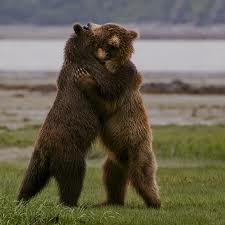
Assuming one is even aware of his or her actions, one never wants to cross personal boundaries and risk making another person uncomfortable or in the case of a drunken bear hug, in danger. Always err on the side of caution.
There is little one can do about drunks other than to remove oneself from the situation. For chums who have a distorted sense of what is proprietary, a simple “Please don’t do that” should suffice. Most people don’t like being punched in the arm or pinched in the stomach or anywhere else. These forms of physical communication should be left on the sports field.


For me a handshake says a lot about a person. It can indicate confidence, friendliness, dominance, weakness, and many, many other characteristics. In my workshops I spend a lot of time demonstrating, discussing, and reinforcing this very important form of greeting. Therefore,I stick to that unless I have established a closer relationship where a mutual understanding has been established. This has nothing to do with being straight. It has to do with being civil.


Saturday, July 20, 2013

Paying It Forward


Even the brain of a young 62 year old can be addled by the heat wave we experienced last week. I was in the grocery store buying a few last minute provisions for a dinner party I was hosting that evening. In the check out line I was cheerily chatting away with a woman ahead of me. She was still loading her purchases into plastic bags as my items were scanned. I suddenly discovered I had forgotten my wallet! I was stunned and horrified and quickly asked the clerk if she would hold everything but the ice cream, which I would return to the freezer, and then go back, fetch my wallet, and return to pay for my groceries. Before the clerk could respond, the nice lady with whom I was chatting said, “Allow me to pay for your groceries.” Naturally I replied, “Oh no, I couldn’t allow that. I’ll just come back in a few minutes.” She insisted suggesting, “You can pass the gesture on one day to someone else.” I graciously accepted her kind offer and thanked her sincerely.


The kindness of strangers is powerful. For her $20 outlay I felt such gratitude, it was as though she had solved a really big problem. No one had ever done this for me before – thankfully I do make a point of carrying money with me to the grocery store. There have been plenty of times when I have helped people in line who needed an extra fiver, but I had never been in such a spot myself. Believe me when I say the feeling is quite different when the shoe is on the other foot.

I am reminded of a time when a friend and I were shopping for groceries one Christmas Eve. We were buying what we needed to make lobster chowder for the people with whom we were spending Christmas. My friend noticed a somewhat disheveled young woman with two small children picking through the bargain bins with a very forlorn expression. He went over to her and asked her if she needed any assistance. She was so happy to hear his voice and his offer. She went on to explain that she was struggling to put a nice meal on the table for her and her children. Without a moment’s hesitation, he said, “It’s Christmas. I want you and your children to have a wonderful meal. I want to give you the groceries as a gift.” Naturally she was dumbfounded and with very little resistance accepted his offer. They went around the store and filled a cart full of turkey and all the fixings for a lovely Christmas dinner. He cheerfully paid for the groceries and carried them to her car, tears streaming down her face.

She said she wanted his address so she could thank him properly. He handed her a business card, gave her a hug and wished her a Merry Christmas. Two weeks later, after we returned from our holiday, a note arrived in the mail from this woman. She was so grateful and her story was so warm and tender. She cooked a beautiful meal for her and her children and because of his gesture could even afford a gift for each of them. The power of that thank you note was so incredible that we both just started to tear up. We have never received a more sincere note or a more cherished gift from anyone.


Giving of oneself is appreciated at all times by everyone – it is a universal human dynamic. Imagine if we all experienced giving and receiving throughout the year –perhaps even more so than we already do? Wouldn’t our world be a different place! I know I will never forget these special times when both giving and receiving made such an impression. It’s just a thought, but why not make a conscious effort to offer a random act of kindness everyday? The benefits are immeasurable, the joy everlasting!