Monday, July 29, 2013

To Touch or Not To Touch - That is the Question


How we greet one another appears to have evolved into a variety and at times bizarre ways of expressing our enthusiasm for seeing a familiar face. A reader wrote to ask about the etiquette of what is or may not be appropriate when we meet others.


Dear Jay:

My question is about appropriate touches between two male friends. I'm not sure if this is the right category for my questions, but I hope you can still help me.

1. I have a close friend who loves women and is a married man. We normally greet each other by fist bump or handshake. Since we are close, sometimes he would greet me by touching me and tickle my chest in a joking way. I think that it is inappropriate for him to touch my chest, but I still think that he is straight.

2. There is another guy at work who would say goodbye sometimes by gently punching a part of your body if there is no opportunity for a handshake or fist bump. Sometimes he would gently punch you in the arm or forearm or your back. Is it all right that he punched me near my right ankle while we were seated? Do you see anything wrong about punching or tapping the thigh part of another man?


3. I had a previous male coworker who would sometimes pinch me in my abdomen. 

I would love to hear your personal opinion, Jay.

Dear Michael,
I have noticed over the past couple of decades that more and more men greet one another more comfortably using fist pumps, hugs, and other friendly touches unheard of a generation or two ago. The formal handshake has been delegated to the boardroom or a formal social gathering. In the old days, a good firm handshake was the true mark of a gentleman; and it was customarily the first physical contact one person had with another. I believe it was the world of sports that introduced us to the fist pump. It was a quick and easy and ever-so-masculine way to acknowledge a good shot or achievement. This was quickly adopted into the business world as a code of coolness. As cool as it may be on the sports field, it doesn’t transfer into the world of business well at all.
Touching other body parts is not a sign of not being straight – it’s simply another manifestation of trying to be cool. Punching people with no intent to harm or hurt is rather Neanderthal and is best reserved for frat houses or sports bars. It has no place in polite society. Why one would touch an ankle is simply bizarre. Touching one’s thigh can be misinterpreted as being a step over the line and is to be avoided.
Pinching another person’s abdomen is also a bit odd and is an unfortunate nervous action most likely.
The other night I was at a smart dinner party. There was a man there who very much wanted to give me a hug, but was concerned about how this action might tarnish his image. He clearly demonstrated throughout the evening, as he became more and more intoxicated, that his image had more to worry about than giving me a hug. I personally do not like to be grabbed by anyone without having progressed through several greeting stages previously, perhaps over a period of time.  This action is one of dominance and puts people off, particularly when alcohol is involved. 
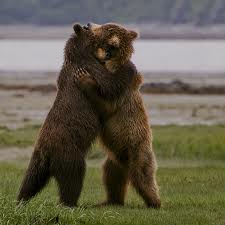


There are some people whom I kiss on the cheek – even some men. This is a custom prevalent in many parts of the world. There are others whom I bow to, and others whom I hug. Most men receive a handshake, as that is what they are most comfortable with.
Assuming one is even aware of his or her actions, one never wants to cross personal boundaries and risk making another person uncomfortable or in the case of a drunken bear hug, in danger. Always err on the side of caution.
There is little one can do about drunks other than to remove oneself from the situation. For chums who have a distorted sense of what is proprietary, a simple “Please don’t do that” should suffice. Most people don’t like being punched in the arm or pinched in the stomach or anywhere else. These forms of physical communication should be left on the sports field.


For me a handshake says a lot about a person. It can indicate confidence, friendliness, dominance, weakness, and many, many other characteristics. In my workshops I spend a lot of time demonstrating, discussing, and reinforcing this very important form of greeting. Therefore,I stick to that unless I have established a closer relationship where a mutual understanding has been established. This has nothing to do with being straight. It has to do with being civil.


Saturday, July 20, 2013

Paying It Forward


Even the brain of a young 62 year old can be addled by the heat wave we experienced last week. I was in the grocery store buying a few last minute provisions for a dinner party I was hosting that evening. In the check out line I was cheerily chatting away with a woman ahead of me. She was still loading her purchases into plastic bags as my items were scanned. I suddenly discovered I had forgotten my wallet! I was stunned and horrified and quickly asked the clerk if she would hold everything but the ice cream, which I would return to the freezer, and then go back, fetch my wallet, and return to pay for my groceries. Before the clerk could respond, the nice lady with whom I was chatting said, “Allow me to pay for your groceries.” Naturally I replied, “Oh no, I couldn’t allow that. I’ll just come back in a few minutes.” She insisted suggesting, “You can pass the gesture on one day to someone else.” I graciously accepted her kind offer and thanked her sincerely.


The kindness of strangers is powerful. For her $20 outlay I felt such gratitude, it was as though she had solved a really big problem. No one had ever done this for me before – thankfully I do make a point of carrying money with me to the grocery store. There have been plenty of times when I have helped people in line who needed an extra fiver, but I had never been in such a spot myself. Believe me when I say the feeling is quite different when the shoe is on the other foot.

I am reminded of a time when a friend and I were shopping for groceries one Christmas Eve. We were buying what we needed to make lobster chowder for the people with whom we were spending Christmas. My friend noticed a somewhat disheveled young woman with two small children picking through the bargain bins with a very forlorn expression. He went over to her and asked her if she needed any assistance. She was so happy to hear his voice and his offer. She went on to explain that she was struggling to put a nice meal on the table for her and her children. Without a moment’s hesitation, he said, “It’s Christmas. I want you and your children to have a wonderful meal. I want to give you the groceries as a gift.” Naturally she was dumbfounded and with very little resistance accepted his offer. They went around the store and filled a cart full of turkey and all the fixings for a lovely Christmas dinner. He cheerfully paid for the groceries and carried them to her car, tears streaming down her face.

She said she wanted his address so she could thank him properly. He handed her a business card, gave her a hug and wished her a Merry Christmas. Two weeks later, after we returned from our holiday, a note arrived in the mail from this woman. She was so grateful and her story was so warm and tender. She cooked a beautiful meal for her and her children and because of his gesture could even afford a gift for each of them. The power of that thank you note was so incredible that we both just started to tear up. We have never received a more sincere note or a more cherished gift from anyone.


Giving of oneself is appreciated at all times by everyone – it is a universal human dynamic. Imagine if we all experienced giving and receiving throughout the year –perhaps even more so than we already do? Wouldn’t our world be a different place! I know I will never forget these special times when both giving and receiving made such an impression. It’s just a thought, but why not make a conscious effort to offer a random act of kindness everyday? The benefits are immeasurable, the joy everlasting!

Friday, June 14, 2013

Crossing the Line


One’s privacy is one of the most important components of an emotionally healthy and happy life. When boundaries are breached into our private lives, we tend to naturally become defensive – usually appropriately, sometimes with great difficulty! This subject has been the topic of several conversations lately and I thought laying down some guidelines is essential to keeping peace amongst friends as well as acquaintances. This instruction will more likely be welcome by the offended unfortunately rather than the offender.


Similar to stepping around sensitive topics when first meeting someone, we should always be mindful of the personal boundaries of other people. I have discussed the rudeness of playing loud music, eating smelly food, wearing too much perfume or cologne and infringing on the ever-quizzical middle armrest. But simple conversations can often lead us into dangerous territory even after we have become more acquainted with others.


Take for example the slightly overweight woman whose stomach is often given a second glance to ponder the “is she pregnant” question. How horribly uncomfortable she must feel as she catches your eyes resting on her midsection a second or two longer than usual. Imagine how shattered she feels when asked when is she expecting – or even IF she is expecting! Sadly this happens far too often and whether the question is delivered in total innocence or as a passive aggressive jab, it has the potential to be very hurtful – and it is rude.

Or what about the newlywed couple, who before they even have a chance to get onto the dance floor for their first dance, someone tactlessly asks, “So when will there be little ones be coming?” First of all, it’s not a kind or necessary question – it goes to the rude side of bad taste, so don’t ask it – ever, not even to your sister! Secondly, it’s none of your business. Such comments are ignorant and discourteous because they are intrusive. One’s family life is off the table when it comes to “interesting” topics, especially when one is just getting off the starting blocks.


Nor do people need false pity and idle gossip. There is the chatter by some pretending to be concerned about a person's plight, who have little or no genuine sympathy. They know full well that there is no real truth about a situation but go on embellishing the story. These people seem to bask in the ill fortune of others, delighting in it, as it makes them feel better about their own miserable lives. I have noticed this form of commiseration often becomes the topic of choice at the local hair salon. It's a heartless pastime. The truth, if there ever was any to begin with, is morphed into exaggeration or lies, which are often times very damaging and hurtful.

I am not suggesting that having compassion for friends and family who are facing current challenges is off limits; I am injecting a word of caution – think. If we were to take a few moments to think about what we are about to say, what our true intentions are, and how the words may affect others, we would save ourselves, and those around us a lot of hurt feelings and a lot of apologies. Most of us can probably remember times in our past when we wish we hadn’t said certain things to certain people. Those comments, which may have been long forgotten by the person offended (or not), can stay with us for the rest of our lives. Just think what a few seconds of careful consideration could have prevented!


We also need to keep in mind the examples we set for our children or those whom we teach or mentor. Gossiping is a habit to be avoided – it’s as bad as smoking to our health and to the health of those around us. Be aware when conversations turn into dumping grounds for hurt feelings, petty jealousies, and moments of anger. It is during these times of heightened emotions when we find ourselves most vulnerable to sudden outbursts. Every time this occurs, the eyes of our children are watching – they’re always watching. And what they see from us, their guides through the murky waters of adolescence, they characterize as acceptable behaviour, when in fact it is not.


Were it possible to wind back the clock and swallow those words we wish we had never uttered, we would be able to relieve those feelings or guilt and remorse that linger after every misspeak. But that is not the way the world works. It is far easier to keep silent than it is to repair hurt feelings. Next time you feel like sharing an opinion or asking a probing question, think again.


Saturday, April 13, 2013

How to Conduct an Interview Like a Pro


Preparing to conduct an interview can be just as daunting a task as being interviewed. We usually think of interviewing people for jobs, but there are other situations such as college placements, summer camp programs, volunteer positions, hiring a tradesman, choosing a doctor or other professional or even going out on a date, where interviewing skills come into play.


How we ask interview questions and connect with the other person influences the outcome greatly. Some people are wonderful interviewers, making us feel good about ourselves even if we don’t get the job, the college admission, etc. Without the ability to interact comfortably with one another, the interview process can quickly break down, often leading to a lose-lose outcome.

One of the first things we must decide is whether to conduct an interview in the first place. After reading a resume or doing our due diligence research in some other way, if the candidate is clearly not going to be a fit, I recommend not going ahead with an interview. Leading someone on as a mere matter of courtesy can appear kindly, but may in fact create unnecessary awkwardness and be a waste of time for both parties. I have read more resumes from people who had no qualifications for a given position than I have from people with qualifications. As interviewer, the choice to meet or not is completely yours.

I recommend conducting interviews on your ‘turf’. This allows the candidate to get a feel for the environment he or she may be working in. Obviously there will be instances when this is neither possible nor appropriate, especially when making initial contact. Recruiters often go to college campuses; dating sites are clearly neutral; and some interviews may take place on their ‘turf’ – a doctor, banker, or lawyer for example.

Prepare a comprehensive list of questions you want to ask ahead of time and be sure they follow a logical sequence. Being organized frees your mind to focus on listening to the answers forthcoming. Listening to comprehend and listening to respond are two completely different processes, the former always being the preferred one! Being prepared ahead of time with a list of questions helps us to ‘avoid the avoidable’, and be in a better position to focus on the other person and on our own organization and impressions.


Ask questions that will elicit thoughtful responses, not simple yes or no answers. This gives you a chance to assess communication skills and a general evaluation of the understanding of the position. Honing the skills required for asking strong,  leading questions takes practice – lots of it. Some of us can develop these skills more quickly than others, but we all improve with plenty of practice. Experience shows and the candidate will notice, and will be silently doing a bit of interviewing him or her self.

Be welcoming and gracious to all candidates whom you interview. Offer a firm handshake and a smile, make appropriate eye contact. This sets the tone for the exchange and makes for a kinder interaction. Never shake hands across a table or desk. Always step around any physical barrier and stand faceto-face. 

Showing one’s humility as an interviewer speaks volumes about how he or she views the world. No one feels comfortable in the presence of someone who comes across as a ‘big shot’; that is simply a bullying tactic, which has no place in an interview – or in civilized society for that matter.

Ask the candidate what questions he or she may have. Be prepared to answer them to the best of your ability. It is helpful to be conscious of the need to discern between facts and feelings at this time. Remember that your feelings about a situation are far different from the facts of the situation. Be mindful not confuse the two.

Once the interview is concluded, thank the candidate for their time and let them know if and how you will be in contact with them moving forward. Walk them to the door, offering a final warm handshake, a sincere smile and appropriate eye contact. These are the ways to show respect to the candidate and the interview process in general.


Tuesday, April 2, 2013

Dress to Impress


Spring has finally arrived and with this change of seasons comes a whole host of personal changes as well. For many young adults the prospect of job interviews is looming. There are job fairs sprouting up like so many daffodils and taking advantage of every possible lead is of paramount importance. However, if one dresses inappropriately, which is a predominant trend these days, you are definitely going to be eliminated from the competition right from the start. Getting into the right frame of mind is a very wise move if one is serious about job placement. Dressing the part will aid one immeasurably to that end.

Recruiters are the first gatekeepers for entry into many companies. The first impression one forms with them can be very important. Learning and executing a proper handshake, making appropriate eye contact ad engaging intelligently with these folks can make a big difference – in fact it can make THE difference. Part of the image one creates is how one dresses. Here are a few guidelines to assist and hopefully help tilt the tables in your favor.


For men:

1.     Be immaculately clean – including your hair and nails. Get a haircut – avoid looking unkempt.
2.     Wear clean pressed clothes that fit properly.
3.     Dress for the job you are seeking.
4.     Shine your shoes.
5.     Wear a necktie – preferably hand-tied – if at all possible.
6.     Your shoes and belt should be the same color.
7.     Your socks and trousers should match, if possible.
8.     Wear a light colored shirt, not a dark one.
9.     Tuck your shirt in all the way.
10. Remove all piercings and earrings. Conceal tattoos.
11. Consult with a trusted friend if necessary

For women:

1.     Dress conservatively.
2.     Do not wear clothing that reveals your body parts.
3.     Wear tasteful jewelry such as earrings, a pin or brooch, a ring or two, and a necklace.
4.     Remove all piercings from face and conceal tattoos.
5.     Wear clothes that fit - not a size too small.
6.     Wear comfortable, clean, low-heeled shoes.
7.     Arrange your hair neatly and with care.
8.     Apply fresh nail polish.
9.     Resist theatrical make-up.
10. Consult with a trusted friend if necessary.

In response to a previous column on wardrobe building, a reader commented that no one would spend $2000 on a suit. Although I strongly disagree, one can find bargains if one tries. I have made many purchases on eBay, as well as many second hand shops, discount outlets and thrift stores. The bottom line is that image does matter. There are many, many more image consultants than there are etiquette consultants because there is a greater perceived need. Image is often conveyed through one’s trappings.

Carrying on from the formal blue suit and black shoes, which are essential to any businessman’s wardrobe, fashions do shift and no longer are brown suits worn exclusively in the country. Many men feel more comfortable in less formal clothing and this is becoming more and more accepted. My traditional eye will tend to gravitate to a dark suit for business, but there are plenty of jobs – most in fact – where a less formal look is just as appropriate.

The same basic guidelines apply no matter what one wears. Be sure your clothes fit properly, are clean, and suit the job. Many people like adding a bit of flair to what they wear, and I am all in favor of that. The guideline in that case is to switch out one piece of clothing, not the whole outfit. For example, a pair of socks, a necktie, a shirt, or a pocket square would add a great accent and show off one’s personality. Be careful not to change all of those elements at once though and wind up looking foolish.

Keeping a professional image is one of the most important elements to being successful. That applies to all jobs. It also applies to all job interviews. The job market is highly competitive today. Many people competing for the same job have virtually identical skill sets. The skills therefore are not going to always be the determining factor of who is the successful candidate for the job. Corporate image is critical. When you apply for a job or even are visiting a recruiting fair, attention to sartorial detail should not be overlooked. Dressing for the part not only gives you an advantage of making a more favorable first impression, it also puts you in the right frame of mind.

Remember the saying that one never gets a second chance to make a first impression; but always be mindful that one always has a chance to make a good impression.